OLIGO Security Crosses $140M in Total Funding with $60M Round to Stop AI-Driven Attacks
Read more

Compare security solutions
Oligo vs. Upwind

TL;DR

Upwind is a runtime-first CNAPP, built on eBPF sensors that watch workloads, network flows, and syscalls to detect threats and prioritize vulnerabilities by real-world exploitability. Oligo specializes in runtime protection across code, apps, AI, and cloud, seeing what's actually executing inside a live application as it happens.

The difference is depth, and how consistently it's applied. Upwind observes primarily from the kernel boundary: network flows, process behavior, and workload identity. Since acquiring Nyx Security in April 2025, it also reaches function level in targeted cases, most notably confirming whether a known CVE's vulnerable function executes. Oligo works at the function level everywhere, continuously, across the whole application. Customers often run both: Upwind for estate-wide posture and network visibility, Oligo for continuous, function-level protection across everything the application runs.


Why Oligo

97%
Share of apps running code you didn't write
Oligo watches what that code actually does at runtime, so nothing borrowed catches you off guard.
1 OpenSSF, 4/26, citing Synopsys/Black Duck OSSRA research
−7 days
The new mean-time-to-exploit
Attackers move before defenders get the chance to patch. Runtime protection closes that gap.
2 Mandiant M-Trends 2026
Nearly 1 in 3
KEVs exploited on or before their CVE was published
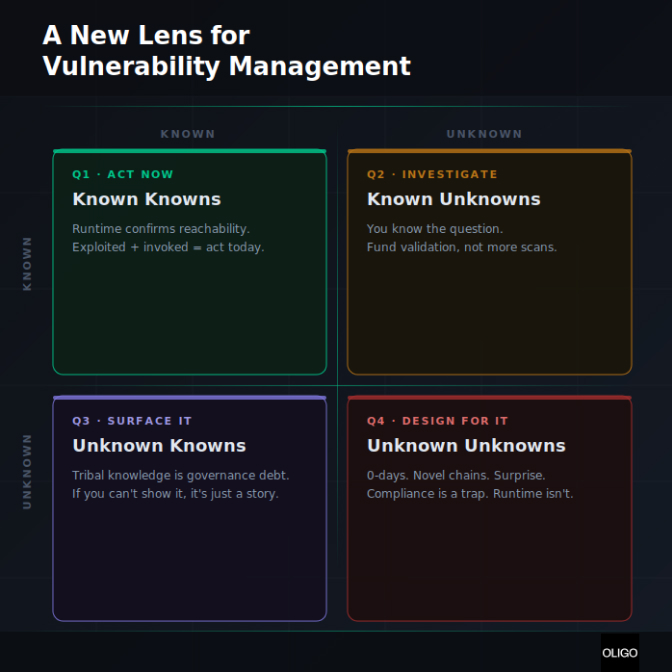
Oligo profiles what your code actually does, so it catches the unknown unknowns.
3 VulnCheck, State of Exploitation 2026 (2025 data)

Comparison

Full
full coverage
Partial
bounded or dependent on conditions
None
not in scope
Unknown
not independently disclosed or verifiable
Category
What it means
Real-time code execution monitoring
Sees what's actually running (executed) inside the app, not just what's deployed
Full
Entire process, all libraries
Partial
Sees syscalls, network flows, and workload identity for general workloads, not code. Nyx-derived function-level visibility in targeted cases, such as confirming whether a known CVE's vulnerable function executes.
Zero-day defense
Catches unknown exploits, not just known signatures
Full
Behavior and library profiling
Partial
Behavior-based detection on workload and network activity; strong for anomalous process behavior, not function-level library profiling
App-layer attack detection
Detects exploits like Log4Shell or Spring4Shell as they happen
Full
Partial
Core detection at the syscall, network, and process level, and Layer 7 API inspection may catch a downstream symptom. Nyx-derived function checks cover known CVEs, not continuous in-process detection of exploits like deserialization attacks.
Blocking without breaking production
Stops an attack without killing the container or app
Full
Surgical: stops the specific kernel activity an exploit attempts
Partial
Automated response acts at the workload or network level, isolating or killing a process or pod. Not built for surgical blocking of a single exploit attempt.
Detection tuning and control
Write rules; silence or dismiss detections
Full
Scope and fine-tune custom detection rules
Partial
Custom Policy Scope tunes existing threat policies; Custom Rules (Graph/Rego/LLM) allow full authoring, but for cloud posture, not workload or application threat detections.
Vulnerability prioritization
Tells you which CVEs are actually exploitable
Full
Runtime proof of execution
Partial
Exploitable Function-in-Use Detection uses an LLM to extract the vulnerable function and exploitation conditions from CVE disclosures, then attaches language-aware runtime hooks to confirm whether that function actually executes. Limited to known CVEs rather than continuous coverage across the whole application, and it doesn't show a call stack.
Reachability analysis
Traces whether vulnerable code can actually be reached
Full
eBPF across full dependency tree
Partial
Language-aware runtime hooks confirm whether a known CVE's specific function actually executes, which is real function-level reachability for that case. Unlike Oligo, doesn't trace reachability across the full dependency tree.
CSPM (cloud posture)
Evaluates cloud configurations against security benchmarks
None
Full
A core strength, and one Upwind has pushed further with runtime-evidence-backed posture validation rather than static scans alone
CIEM (identity risk)
Identifies overly permissive identities in the cloud environment
None
Full
Identity and access management is part of Upwind's consolidated platform, with runtime context layered in
AI-SPM (AI security posture)
Knows which AI models, SDKs, and components are actually in use
Full
Runtime, function-level
Partial
AI-SPM and AI-BOM inventory models, frameworks, and agents from static code, cloud, and runtime, including dormant components. No runtime confirmation of which components execute.

Why Customers Choose Oligo

Upwind answers "what's happening across my workloads, network, and cloud identities, and is any of it exploitable." Oligo answers "what is this specific application doing right now, down to the function, and is any of it being exploited."

Both approaches lean on runtime evidence over static scans, which is a real point in Upwind's favor, and its Nyx acquisition has added function-level checks for known CVEs. But its core sensor still works at the workload and syscall level, outside the application process. Oligo's Deep App Inspection goes inside that process, instrumenting function calls, libraries, and model invocations directly, so it can confirm exploitability with call-stack evidence and block an exploit without touching the container around it.


oligo security . runtime security . STOP ATTACKS IN REAL TIME . oligo security . runtime security . STOP ATTACKS IN REAL TIME . oligo security . runtime security . STOP ATTACKS IN REAL TIME . oligo security . runtime security . STOP ATTACKS IN REAL TIME .

Don't just scan passively.
Protect actively with Oligo.

BOOK A DEMO
oligo security . runtime security . STOP ATTACKS IN REAL TIME . oligo security . runtime security . STOP ATTACKS IN REAL TIME . oligo security . runtime security . STOP ATTACKS IN REAL TIME . oligo security . runtime security . STOP ATTACKS IN REAL TIME .